Applications deadline: 02/28/2026 at 11:59PM EST.
Our application requires a Gmail account (or the creation of one), written responses to application questions, uploading a single PDF (CV, references, and work samples).
We recommend reviewing the full sample application here before applying.
If you encounter any issues with the application form, please email residency@goelsewhere.org.
Context
Sylvia Gray ran a second hand, surplus, thrift store over nearly sixty years, relentlessly collecting everyday things. The store, over her lifetime, became a living archive of objects, stories, and material cultures. After her death, this vast accumulation became the foundation for Elsewhere Living Museum: a site for collaborative creation where artists engage the collection as medium, artifact, and collaborator, adding new work to this transforming vision, that, “with people and things, we build collaborative futures.”
For over 20 years, Elsewhere’s international artist residency has been dedicated to site-specific experimentation, social action, and interdisciplinary collaboration. It is embedded in a city shaped by immigration, textile history, civil rights activism, higher education, and cultural and economic growth.
Residencies Overview
Under one roof, Elsewhere is a dense, living, and self-contained ecosystem: 15,000 square feet of layered materials, histories, and past projects where nothing new enters and nothing leaves. For one focused month, the entire collection becomes your medium—no blank walls, no default materials—everything is site-specific and responsive to context, constraint, and community. Artists arrive with habits and depart with breakthroughs; your work stays in the museum, joining a living archive and a network of 700+ alumni across two decades.
The offer is simple and sustained: $2,500 for four weeks, including a private room, a stocked pantry, workshops, 12,000 square feet of workspace, and an astonishing density of materials. We sustain a living organism: building, collection, staff, care, and public life. Don’t arrive with a fixed plan; arrive ready to discover what Sylvia’s world reveals about your practice.
Four-Week Foundational Residency Timeline
Four-week arc:
Week 1: Artist talk + deep orientation to the collection, building, and community
Week 2: Focused making with curatorial support and check-ins
Week 3: Public workshop sharing process with Greensboro
Week 4: Opening celebration of completed work
- Actual residency length: 27 days, with flexibility.
Two-Week Research Residency Timeline
Two-week arc:
Day 1: Arrival
Day 2: Welcome and orientation; set shared research goals and practices
Day 3: Survey of Elsewhere’s collection, building, and regional sources
Day 7: Research check-ins
Day 14: Opening celebration of your research
- Actual residency length: 15 days, with flexibility.
Eat together, make together: dinners (5/week), structured support, critiques when needed, plus outings. • 27 days, ~5 artists, 700+ alumni.
Fees
$2,500 for four weeks.
$1,500 for two weeks.
Includes: private room, stocked pantry, workshops, 12,000 sq ft of workspace, a world of materials, group exhibition, and a 700+ alumni network. ~$100/day.
$500 non-refundable deposit due upon acceptance.
What your fee sustains: a living, breathing organism—historic building, dedicated staff, and vital infrastructure—so your site-specific work can thrive within Elsewhere’s evolving archive. You keep digital editions and documentation; collection-based works remain on-site, and select projects may be lent for external exhibitions.
Scholarship Programs
Elsewhere is unable to offer any scholarship programs at the moment, though we are working hard to restore these opportunities in the coming years.
2026 Residencies
2 week Research Residency
RESIDENCY #118: 06/07/2026 - 06/21/2026
RESIDENCY #119: 07/04/2026 - 07/18/2026
Foundational Residency
RESIDENCY #120: 08/13/2026 - 09/09/2026
RESIDENCY #121: 10/15/2026 - 11/11/2026
Expectations & Opportunities
All invited residents sign a contract covering artwork and residency agreements, liability and media releases, equipment loan terms, fellow payment, invoicing, contact details, and community guidelines—providing a clear picture of the culture we aim to foster. Each resident must pay a non-refundable deposit of $500 Each resident is required to attend a mandatory check-in by phone or Zoom two months before their residency to confirm participation.
Residents receive room and board; access to materials, tools, and equipment; opportunities for public engagement and programming; documentation and promotion of their work; and representation both online and within the museum.
This year, we’re expanding our offerings to include research residencies, in addition to production-focused ones. Artists may now use Elsewhere as a research hub, even if they don’t produce a permanent installation.
Production guidelines for residency projects
The museum’s collection is treated as a limited natural resource.
Any changes or projects involving the collection are authorized solely by curators and directors, who prioritize sustainable, ongoing use and community engagement.
All projects and documentation remain with the museum, allowing future artists-in-residence to reinterpret and transform work through ongoing collaboration.
Obligations and opportunities
4 Week Foundation Residency
Make for four weeks: immerse in studio practice, build new work from daily time in our spaces, and draw from Elsewhere’s collection, community, and rhythms to deepen your craft.
Attend orientation sessions: Residency (2 hours), House (1 hour), on day 2
Prepare one group dinner (2 hours) during the week and participate in nightly kitchen clean-up
Present an artist talk introducing your work and practices
Meet with staff to discuss your project proposal
Join the weekly House meeting (30 minutes) and participate in group cleaning (1 hour)
Maintain daily upkeep of your room and shared/public spaces
Participate in a community dinner with Elsewhere’s members, collaborators, and friends
Host a Workshop: works-in-progress open house and interactive session
Work with curators on finalization: titling, project description, future engagement and maintenance
Present your new work at First Friday Happenings
Participate in media-swap, in which Elsewhere provides its professional documentation and you share your personal documentation of your work and Elsewhere materials.
Complete final clean-up of room, studio, and production areas
Take a family photo and celebrate residency departure
2 Week Research Residency
Dive into a focused two‑week inquiry: explore Elsewhere’s collection, building, and histories—or use Elsewhere as your regional hub to connect with communities, sites, and networks beyond the museum.
Shape your time: arrive with a simple plan and evolve it through two curator/staff touchpoints tailored to your project.
Live and work with care: you’ll have a private room, 24/7 studio access, and guided pathways into our archival resources.
Join the community: orientation, shared meals from a generously stocked pantry, and space for informal exchange with fellow artists.
Share your process: close with a short, public‑facing moment—an open studio, talk, walk‑through, or reading—to spotlight what you’ve been working on.
Leave a trace: contribute 3–5 images or a brief reflection to Elsewhere’s living archive so future artists can see and build from your work.
Benefit from visibility: documentation support and inclusion across Elsewhere’s channels, connecting you to our 20+ year network of alumni and collaborators.
Eligibility
Elsewhere embraces an expansive view of creative practice and actively seeks artists with diverse voices, experiences, and perspectives to strengthen our collaborative community. We welcome established artists with a sustained practice, body of work, and exhibition history who are ready for radical creative disruption and a transformative, context-driven, materially saturated experience. Applicants must be at least 18 years old.
Elsewhere thrives with makers, doers, and thinkers across disciplines who value co-creation, reuse, public engagement, social practice, and collective experimentation. Artists who succeed here are skilled in their medium yet eager to take risks, work beyond boundaries, and let context and curiosity push their practice in new directions. Collectives, collaborative groups, international artists, and commuter residents are all welcome —anyone ready to engage deeply with creative possibility finds a place at Elsewhere.
Artist Assessment Criteria
Ideal candidates demonstrate site-specific thinking, transformative imagination, and resourcefulness, with experience working in non-traditional spaces and refining their concepts and materials.
Successful residents work independently and adaptively, engage generously with their cohort and the wider Elsewhere community, and approach collaboration with inclusivity and care.
Above all, applicants should see clear value in how the residency will support their personal, professional, and artistic growth.
Application Review Process, Notification, and Acceptance
Selection: All applications are carefully reviewed by staff and former artists.
Notification: All applicants will be notified by 03/20/2026.
Confirmation: Accepted residents must sign a contract and pay non-refundable deposit within one month and confirm attendance two months before the residency begins.
Facilities & Services
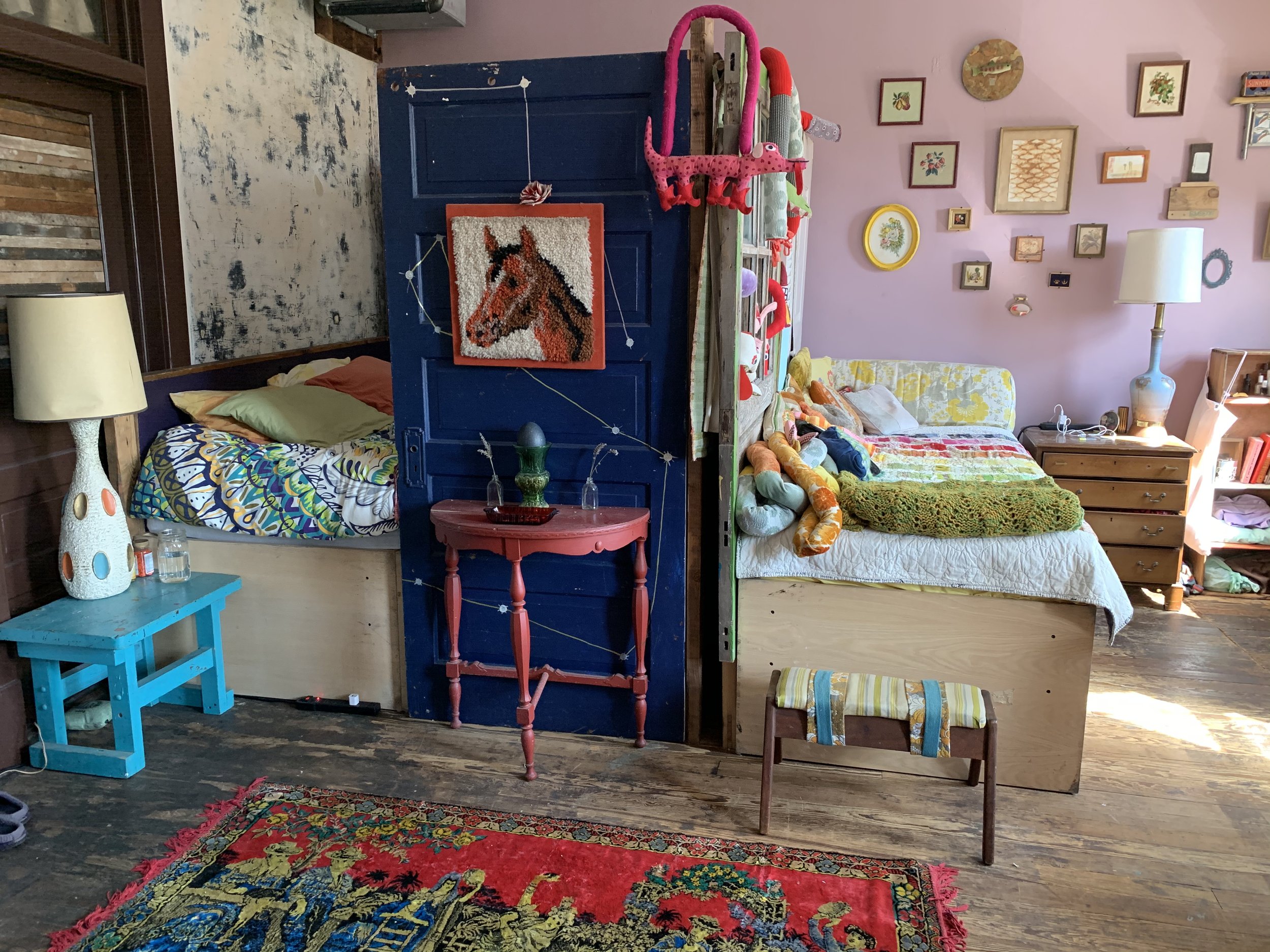
Elsewhere bedroom. Photo: Thea Cohen
Accommodations
We aim to offer accommodations that support every resident’s participation and success.
While the environment retains a rustic character, we upgraded key features in 2016: installing heating and air conditioning (HVAC), adding emergency exits and safety egress, and implementing fire alarms, sprinkler systems, and monitoring. The first floor is fully ADA accessible, and all bathrooms are single-stall and gender-neutral.
Living Arrangements:
Residents immerse themselves in the collection, living and working throughout three interconnected floors of our artist-transformed living museum. Each artist enjoys a private bedroom—perfect for resting or use as personal studio space—along with access to shared bathrooms and an on-site washer and dryer.
Food & Community:
We run a vegetarian food coop in our artist-designed Kitchen Commons, placing weekly grocery orders with input from residents. We use produce from our garden and local food surplus whenever possible. The kitchen is open 24/7 with two ovens and ample gear. Shared dinners are prepared five nights a week by staff and rotating residents, while breakfast and lunch are self-directed.
Residents are welcome to have guests. We will ask that they contribute to food costs if they eat with us and overnight guests must be approved ahead of time.
Significant others and/or collaborators who would be joining residents must be included in the original application.
Trained service animals are welcome, provided official documentation.
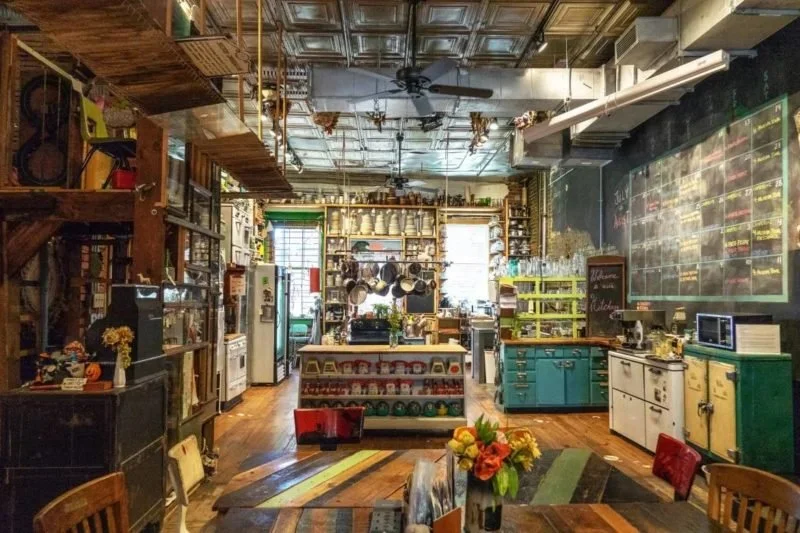
Elsewhere’s Kitchen Commons
Production Resources
Studios:
Residents have access to diverse workspaces inside our 120-year-old building—including studios for woodworking, textiles, tech lab, printmaking, storefront theater, vintage wardrobe, public kitchen, and a garden.
Materials:
Artists work with an extensive archive of vintage materials dating back to the early 20th century—textiles, toys, books, consumer technologies, clothing, thrift items, and more, all ready for creative transformation. A small budget is available for essential materials, but the Elsewhere experiment prioritizes using what’s on hand.
Production Support:
Our Residency Director guides both creative processes and use of the collection, offers critical feedback, supports public events, and connects residents with Greensboro neighbors and our international network. We provide documentation, promotion, press, and social media support, and projects are permanently represented in the museum and online.
Community Access:
With five to six residents at a time, Elsewhere fosters a collaborative environment for peer learning and experimentation. We host visits from local, regional, and national curators and arts organizations to offer feedback and expand professional networks.
Residents engage with the public through open studio hours, shared meals, artist talks, events, and informal gatherings. After their residency, artists join E.T.C. (Elsewhere Tenured Collaborators), gaining ongoing access to our global alumni community and resources.
Testimonials
The Elsewhere artist residency was a vital catalyst for important shifts in my studio practice. Leaning into story, materiality, and play are a truly unique part of the elsewhere experience. It is impossible to describe unless you too have immersed yourself in this special place. I created work that not only pushed me out of my comfort zone, but helped me build confidence and believe in myself as a conceptual artist. Elsewhere is a special space and if you lean into it, your time there will help you work from a renewed place of empathy for objects, histories, and yourself.
—Charis Fleshner (’21 & ‘24)
“Being a resident at Elsewhere is one of the most memorable experiences I have had to date as an artist. The freedom and encouragement to play and discover new and dormant parts of my practice was invigorating and has given me inspiration, impetus, and tangible tools to continue working with long after the conclusion of the residency. As an artist-parent, the residency was very accommodating and I didn’t feel judged for needing to split my time arting and parenting. Quite the contrary. The flexibility and understanding on the part of the staff made the success of my residency possible. It gave me the confidence to ask for what I need and to seek more balance as I do other artistic work. I miss being at Elsewhere these days, but the effort to keep alumni involved has eased that feeling and I am so happy to still be in orbit with the museum. I feel seen, I feel included, and I feel like I can tap into the community whenever I need, from now on.”
—Cara Hagan (’21)
“I am an artist and art historian who has presented visual and scholarly work throughout the United States and in the U.K., Canada, Belgium, and the Netherlands. I was a Southern Constellations Fellow at Elsewhere in February 2019. Because of my experience there, Greensboro holds a special place in the geography of the contemporary art world […] alongside such locations as Skowhegan, Maine; Marfa, Texas; Joshua Tree, California; and Yaddo, Vermont. What makes these locations so desirable is not the mere presence of notable collections (many cities have such assets), but the fostering of an environment for the creation of new work and for forging relationships with other artists. Elsewhere has done this since its beginning, built on the remarkable and unique legacy of original proprietor Sylvia Gray, and I can imagine an immense legacy to be proud of when looking back in fifty or a hundred years.”
—Josh Franco (’19)
“Elsewhere runs a strong artist residency program, based on trust in artists and an embrace of collaboration in all its forms. The organization’s support for artists who take creative risks and build meaningful peer and community relationships through their work, aligns well with the foundation’s belief in the value of experimental practice and the importance of artistic participation in cultural and civic conversations.”
—Rachel Bers, Program Director, Andy Warhol Foundation for the Visual Arts
Read this great NEA interview with Carolyn Mak (‘10) about the residency.
Ready to be challenged and inspired in remarkable, unexpected ways?
This is not a typical residency. This is Elsewhere, a singular island and closed system of objects that will challenge every assumption you have about your practice and lead to transformative shifts you never saw coming.
Applications open 01/15/26 | Deadline 02/28/26
Non-refundable $500 deposit required upon acceptance.
Frequently Asked Questions
How often can I apply to Elsewhere’s residency program?
You can apply yearly, during every application cycle.
How often can I take part in Elsewhere’s residency?
There are no limits on how often you can take part in Elsewhere's residency.
Can I bring family/partners?
Due to limited space, residents can only have overnight visitors for a maximum of 3 nights, with a $100 a night charge to cover room and inclusion in our food coop.
You have a vegetarian food coop, is meat allowed?
Meat is allowed, but must be purchased by the residents themselves.
Can I bring animals?
Only registered service animals are allowed. You must provide us with papers to confirm their status. These animals will be solely the responsibility of their owner. That said, Elsewhere is full of many small and possibly dangerous niknaks and pets are generally discouraged.
Does Elsewhere have quiet hours?
Yes. As this is a communal living situation, Elsewhere operated quiet hours from 11pm to 10am. If artists living together choose to expand these based on consensus from the entire group, this is allowed.
Can I take my work with me?
Any artwork made using materials from Elsewhere’s collection must stay as part of the collection—these physical pieces cannot leave the museum.
If you create digital works, those are yours to keep, though we ask you to leave one complete edition for the museum’s archive and exhibition.
For works made as part of an edition (like prints or multiples), you may take extras with you as long as one version stays at Elsewhere to represent your residency.
I am part of a collaborative, can I apply as a group?
You are free to apply as a collaborative, however please keep in mind that all members of the collaborative will be required to pay the full residency fee, as well as share a bedroom.
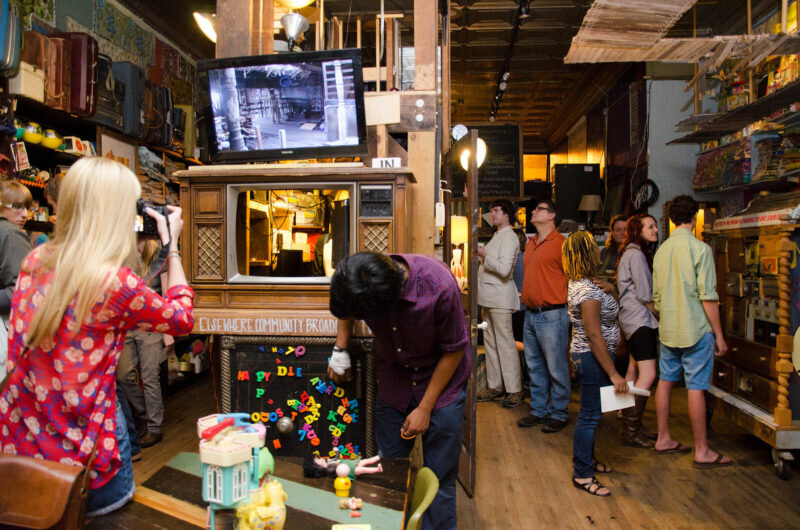
Visitors exploring Time Machine by resident Ali Momeni (‘12)

Mixed by Southern Constellations Fellow, Lonnie Holley (‘18). Photo: Amelia Nura.
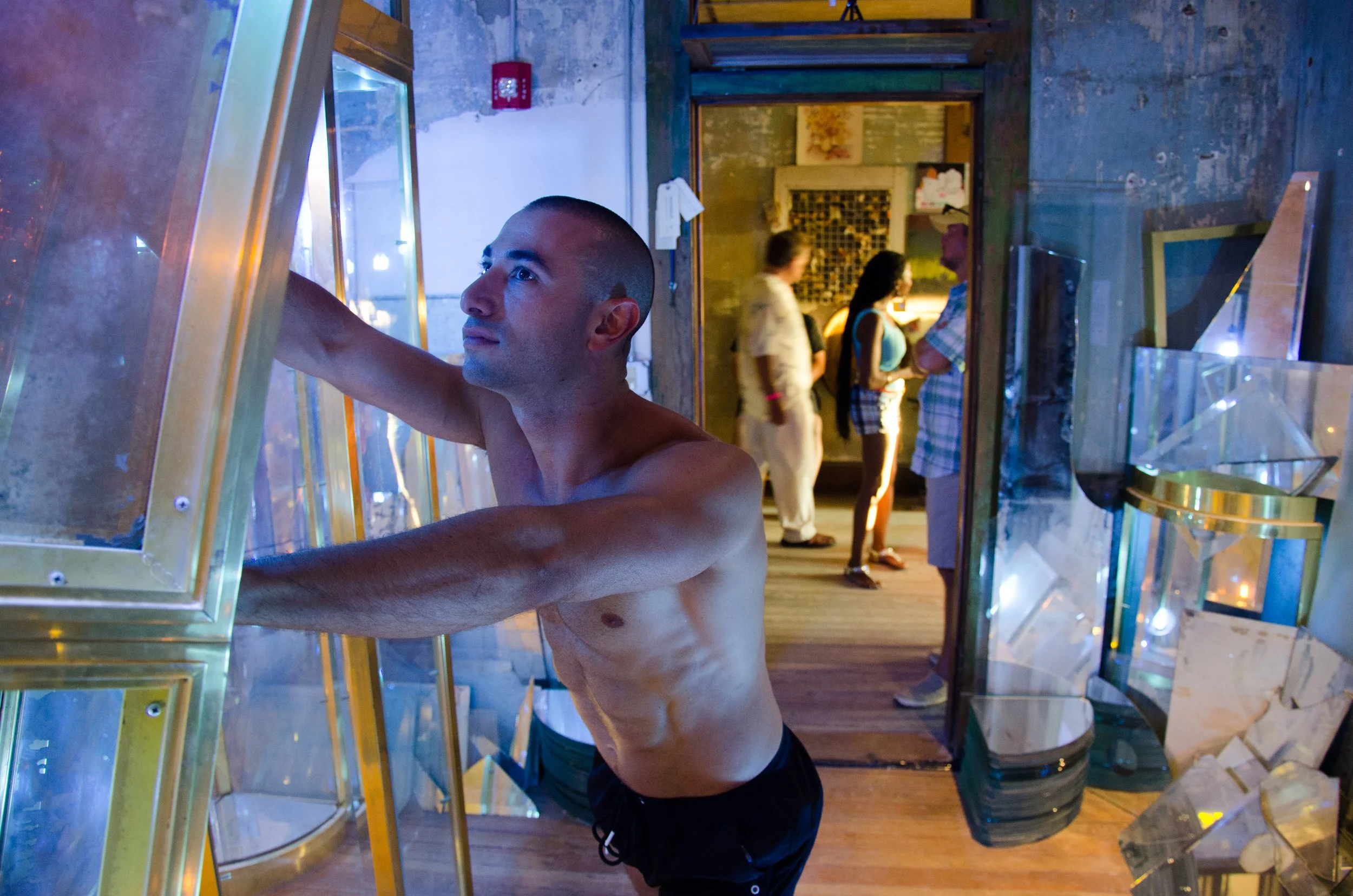
A Love to Last 13 Hours by Urban Exchange Fellow: Miami, Pioneer Winter (‘16). Photo: Gui Portel
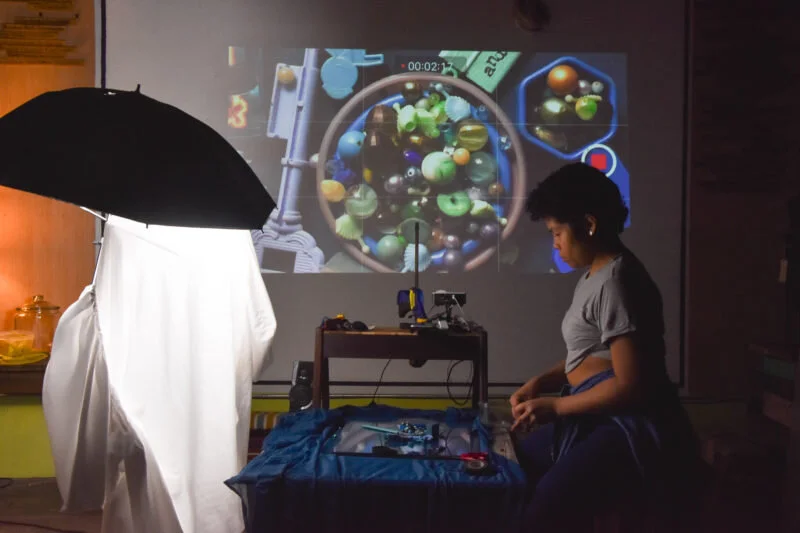
Documentation of ASMR video production and “Slime Social” for Social Sensory Stimulation by Diana Laurel Caramat (‘19). Photo: Amelia Nura